
Monday, Nov. 2 —
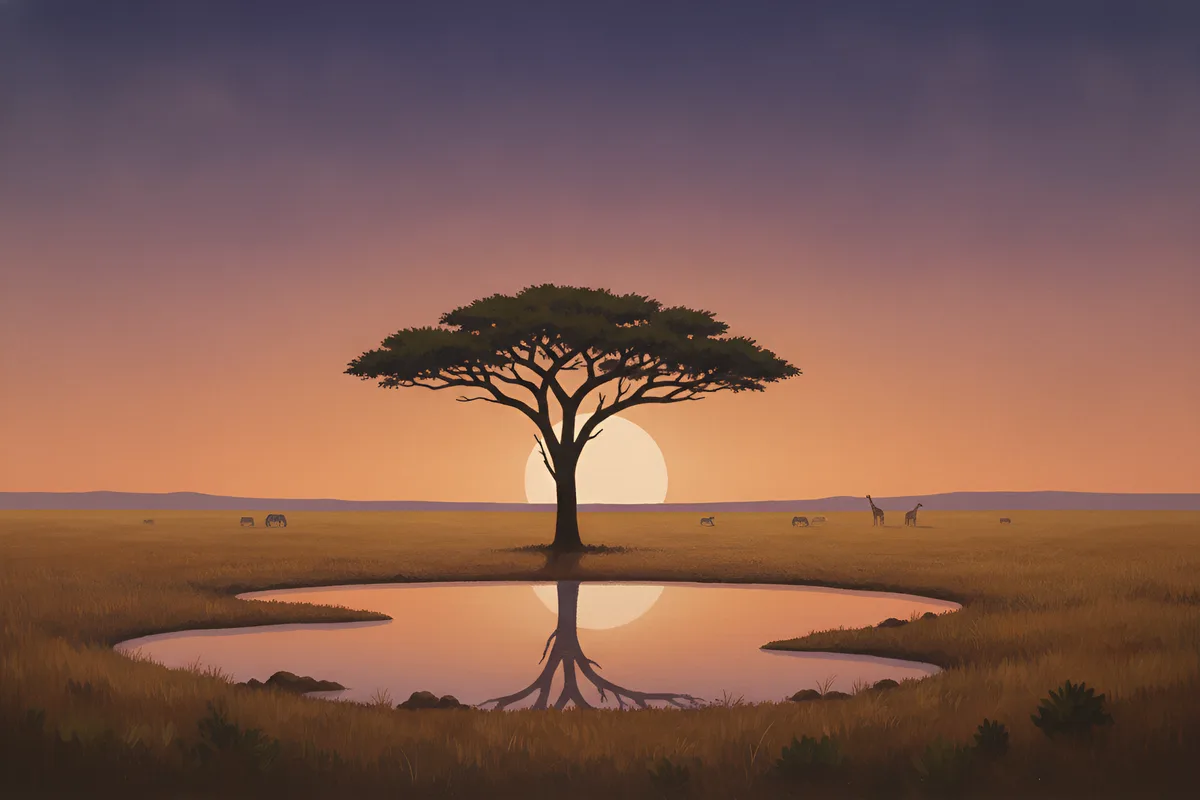
The plain runs flat in every direction, and for a moment at the end of the day nothing on it moves quickly. The grass has gone the colour of old brass, and far off, small as punctuation, a few zebra and two giraffes drift along the horizon, taking their time over the last of the grazing.
At the centre stands the acacia. Its crown spreads wide and level, a dark umbrella of leaves held up by a trunk that forks and forks again, and every bare twig is drawn cleanly against the sky. Behind it the moon is just clearing the land, round and pale and still faintly warm with the colour of the horizon it has only now left.
The sky does most of the quiet work. Near the ground it glows apricot and rose, then cools through a dusty mauve and settles into a deep indigo overhead, with no hard edges anywhere, only a slow change of colour. The paint is flat and matte, laid in broad decorative shapes in the spirit of the Nabis, so that the whole scene feels less like a record of a place than a remembered feeling of it.
Below, the waterhole is a still oval of reflected light. The tree grows downward into it, root-like, and the moon sits in the water as a soft pale lozenge. Nothing disturbs the surface. The animals have already drunk, or are about to, and the evening seems to be waiting politely for them.
It is a painting about patience and about scale: one tree, one moon, one patch of water, and a very large amount of quiet around them. The longer it is looked at, the more the colours seem to hum, indigo against apricot, dark against light, the day handing itself over to the night without any fuss at all.