
Saturday, Oct. 31 —
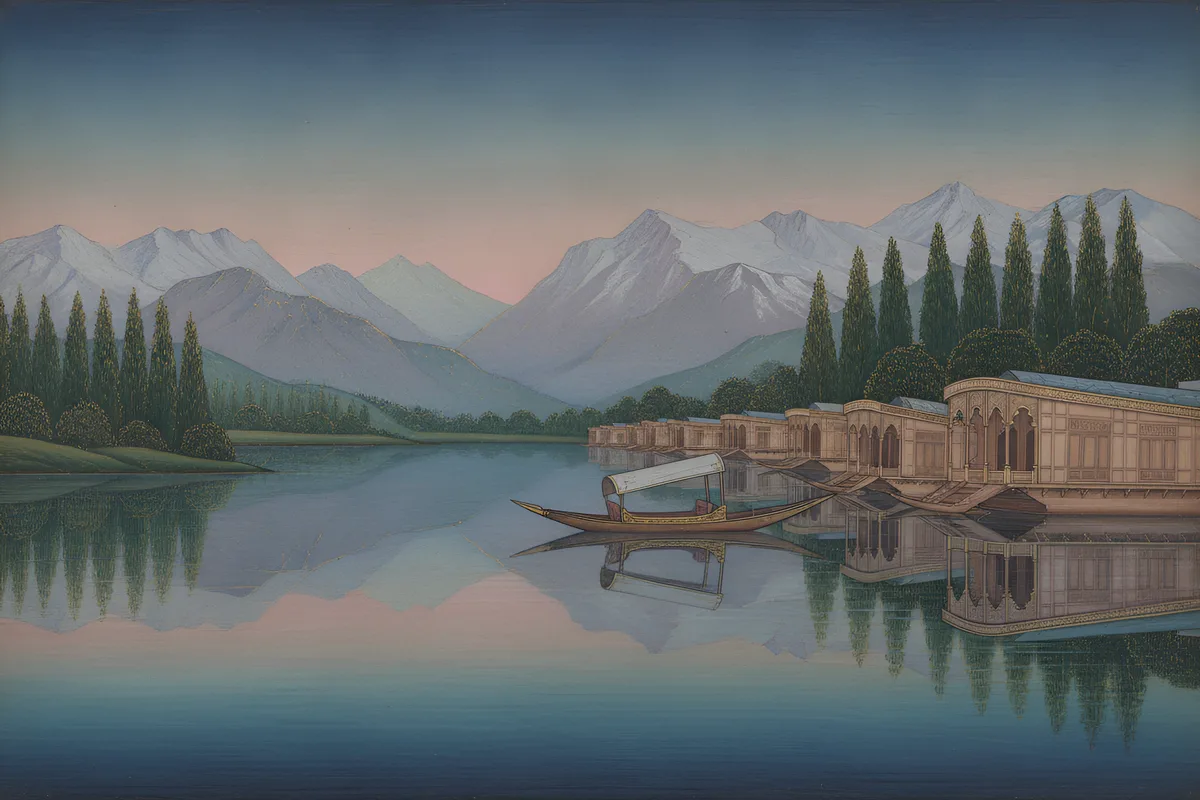
The hour before sunrise is the quietest the lake ever gets. The sky above the mountains has not yet decided on a colour, and so it holds several at once: indigo at the top, a thin band of rose along the ridgeline, and a pale, greenish silver where the two meet. Nothing moves. The water has taken the whole scene into itself, peaks and poplars and the long wooden houses, and gives it back slightly softer, as if remembered rather than seen.
At the centre, a single shikara rests with its pale canopy drawn up like a folded wing. Its slender hull is edged in gold, the only warm bright thing on the water. Beside it the houseboats stretch away in a line, their carved cedar fronts lined with arched windows and fine lattice work. Every panel has been painted with patient attention, the way a miniature painter might spend a week on a single doorway.
Along the shore, the cypress trees stand dark and upright, their reflections hanging beneath them like inked brushstrokes. Rounded trees with flecks of gold in their leaves soften the line where land meets lake. Behind them the mountains rise in layers, each one paler than the last, until the highest snow takes on the faintest lilac and rose of the waking sky.
The painting borrows the flat, luminous planes of colour and the delicate gold detail of old miniature painting, but it keeps the stillness of a real morning. Nothing is hurried. There is no wind to ruffle the water and no one yet to climb into the boat.
It is the kind of scene that rewards a long look. At first there is only a blue calm, and then the carving appears, then the gold on the hull, then the second, upside-down world below. By the time the eye has taken it all in, you can almost sense the light about to change, but the painting holds it at the exact moment before.