
Thursday, Nov. 5 —
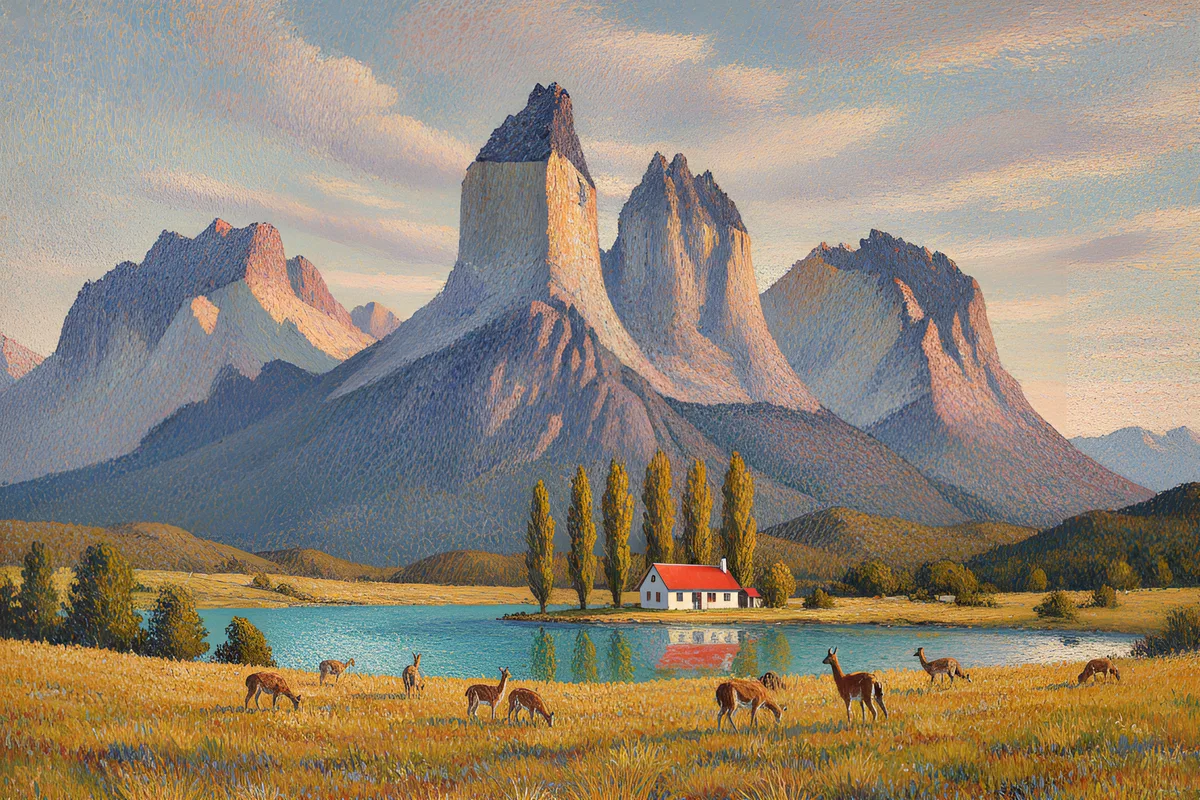
At the far southern end of the continent, the land opens into a steppe so wide that a single white house can hold the whole horizon together. Here it sits on a little spit of ground at the edge of a turquoise lake, a red roof the one bright note in a world of gold, slate and rose.
Behind it, the granite towers rise like three great fingers pointed at the sky. In the late afternoon the sun comes in low from the side, and their upper faces glow the colour of a warm peach while the shadowed flanks fall away into violet and blue. The clouds are slow and streaked, drawn out by a wind that you can almost see moving through the grass.
The painting is built from thousands of tiny dabs of pure colour, set side by side rather than blended. Up close, the lake is a scatter of turquoise, green and cream; step back, and it becomes one clear sheet of water that holds the poplars and the little house in a shivering reflection. The same trick turns the foreground into tussock grass, where orange, ochre and flecks of blue lavender glitter like something just disturbed by the breeze.
A herd of guanacos grazes along the shore, unhurried, their tawny coats the same colour as the grass they stand in. They make the scene feel lived in and quiet, as though the day's work were done and the whole valley had agreed to pause.
The row of poplars is the heart of the picture. Their narrow, upright shapes echo the towers behind them, small green-gold copies of the great stone spires, planted by someone who wanted shelter from the wind and a little beauty in the bargain. They stand at the centre of the canvas, and the eye keeps returning to them, then to the red roof, then up the long slope of the mountain to the pale rose summit.
It is a landscape of contrasts that never quarrel: the warmth of the grass against the cool of the water, the hard stone against the soft cloud, the tiny house against the enormous sky. The light is the kind that lasts only a few minutes, and the painting holds it still.