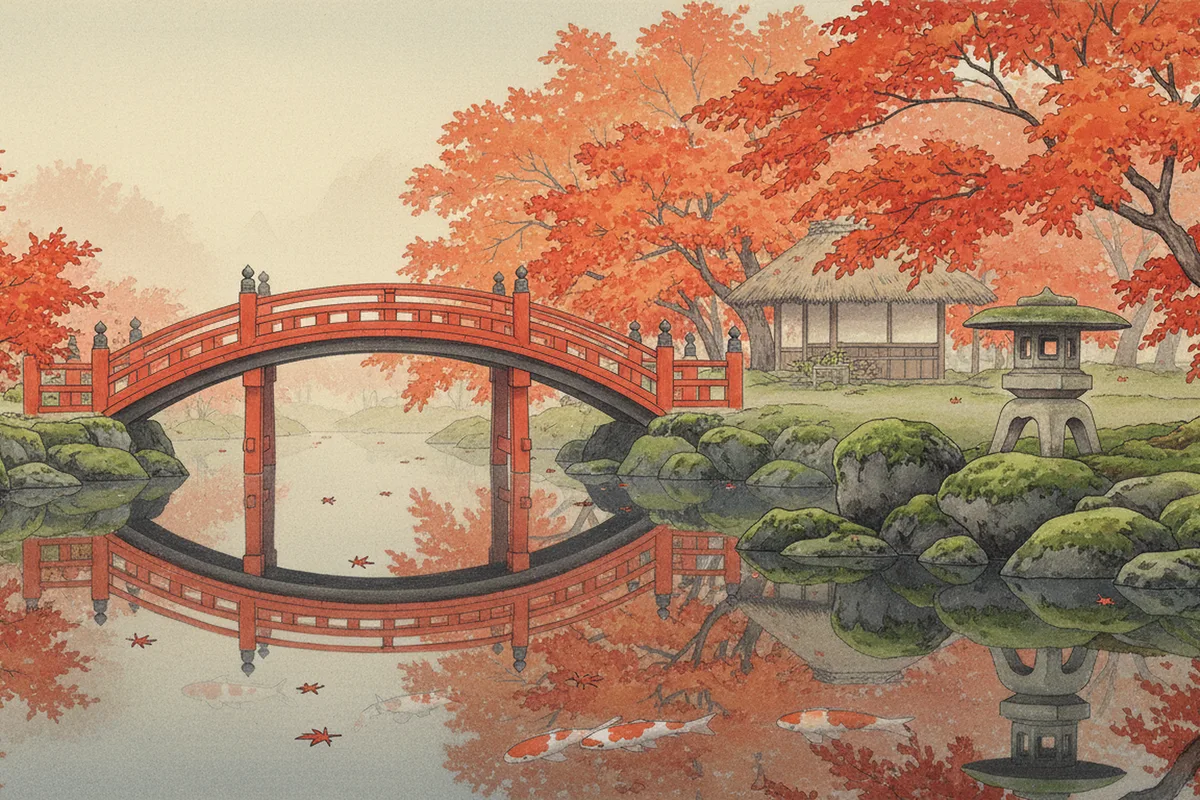
Early on an autumn morning, before any visitors arrive, the garden belongs to the mist. It hangs over the pond in a soft, pale veil, softening every edge and turning the far trees into gentle shapes of coral and cream.
Across the middle of the pond arches a small bridge, painted a deep vermilion. Its rails are delicate, its posts capped with dark finials, and its curve is so perfect that the reflection below completes it, closing the arch into a full oval of red on the water. It is the kind of bridge meant not for hurrying across but for stopping in the middle and looking down.
Above and around it, the maples are at their peak. Their leaves blaze in vermilion, persimmon and orange, filling the upper half of the picture with colour, and a few have already fallen, floating on the surface of the pond like small red stars. Beneath them, koi drift slowly in the clear water, their orange and white bodies just visible below the surface.
On the right, mossy boulders gather along the edge of the pond, rounded and soft, and a stone lantern stands among them, grey and weathered, its cap furred with moss. Behind it, a small thatched tea pavilion sits among the trees, its paper screens pale and closed. Everything is arranged with care, the way a good garden always is, so that it feels both natural and composed.
The painting is made in the style of nihonga, using ground mineral pigments and fine ink outlines on a warm, cream ground. Colours are matte and gentle, lines are precise, and there is a sense of stillness throughout, of a moment held exactly as it is.