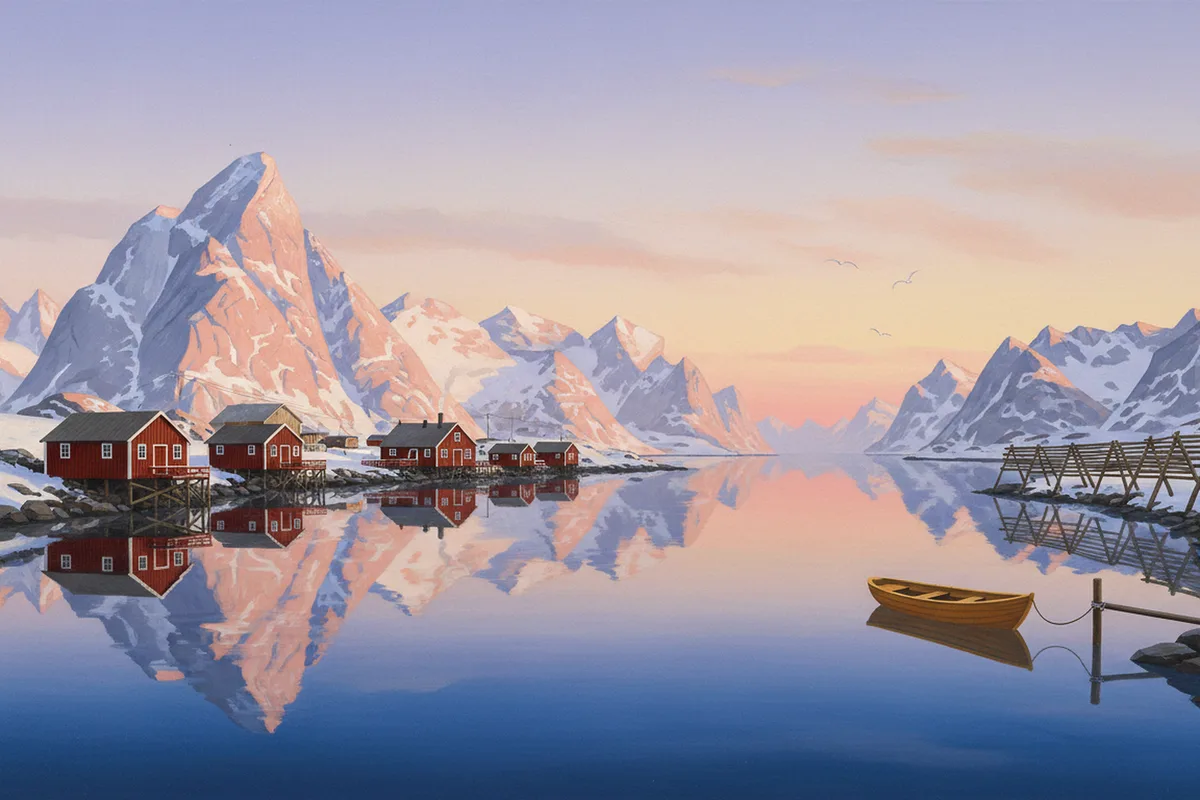
Dawn comes slowly this far north. The sun stays somewhere below the mountains, but its light has already reached the highest peak, which glows rose and apricot against a pale lemon sky. Everything beneath it is still waiting in the blue hour, and the fjord is so calm that the mountains appear twice, once in the air and once again, softer and deeper, in the water.
Along the left shore, a row of red fishermen's cabins stands on wooden stilts at the water's edge. Their crimson walls are the warmest thing in the scene, and they lead the eye from the foreground into the bay, growing smaller toward the far end of the village. Each one has a double in the water, slightly darker, as though the village has a quieter twin living just below the surface.
On the right, the long timber frames of the drying racks march along a rocky bank, their crossed poles sketched as fine dark lines against the snow. Below them, a small ochre rowing boat rests on the glassy water, tied to a post by a loose loop of rope. It is the closest thing to us, and it gives the whole picture its sense of scale. A few gulls drift high over the inlet, the only movement in the morning.
The palette moves from cool to warm in gentle bands. Deep fjord blue holds the lower edge, lifting into slate and lilac, then pink where the reflected peaks meet the water, and finally into the soft gold at the horizon. The shapes are simple and flat, with smooth planes of snow and rock, so the quiet comes from the colour as much as from the scene itself.
It is the kind of moment that lasts only a few minutes: the village still asleep, the boats not yet out, and the mountains catching the first light before anyone else can.