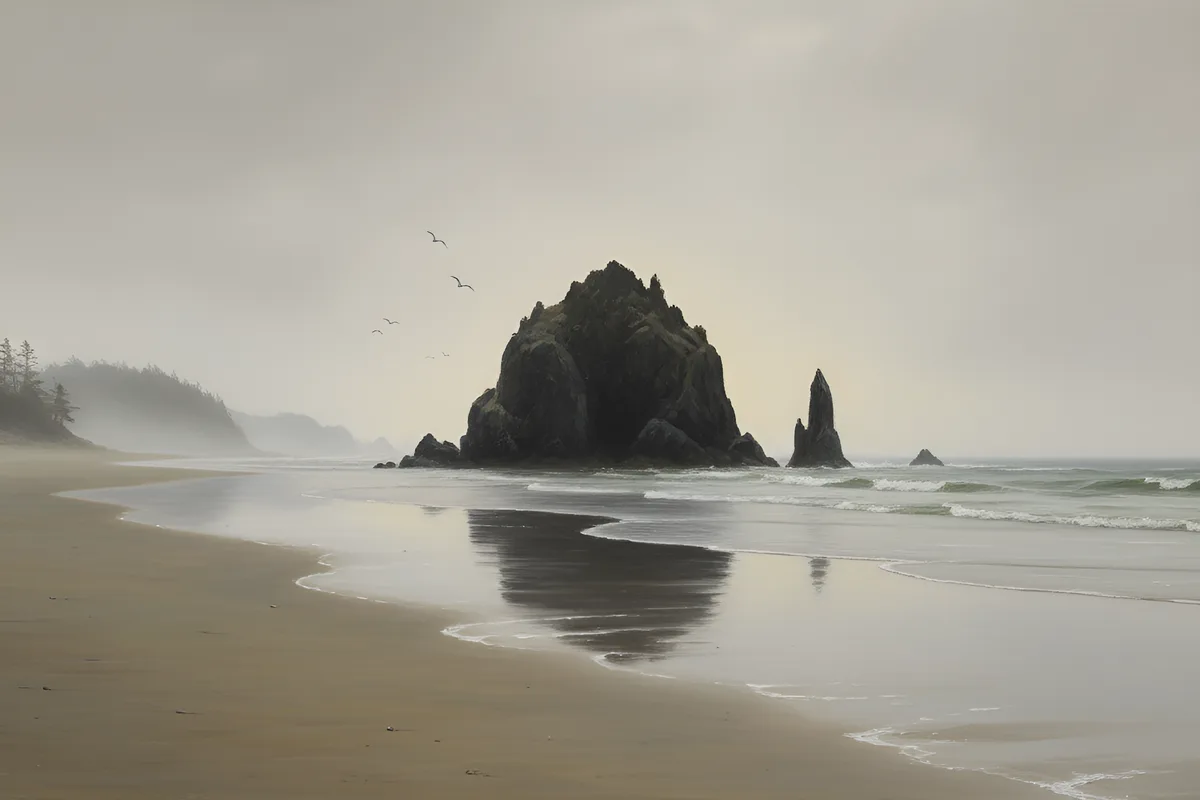
On this stretch of the Pacific coast, the fog rarely lifts completely. At midday the sun is somewhere above the marine layer, but all that reaches the beach is a soft, even pearl light that seems to come from everywhere at once. Colours fade, edges soften, and the whole shore becomes a study in grey.
In the middle of it all rises a great sea stack, a massive dome of dark basalt standing alone in the shallows. Its sides are rough and cragged, tufted here and there with a little green where hardy plants have found a hold. Beside it stands a slender spire of rock, thin as a needle, and farther out a single low rock breaks the surface of the sea.
The tide is out, and the beach in front of the stack has become a mirror. A long sheet of wet sand reflects the rock almost perfectly, a dark shape trembling on a silver ground, and thin lines of foam slide in and out along its edge. The waves beyond are small and gentle, rolling in white ribbons toward the shore.
On the left, a headland covered in dark spruce rises from the beach and fades into the mist, its farther ridges no more than pale outlines. A few seabirds circle high above the stack, small dark marks against the pale sky, the only movement in the scene.
The painting is made in the manner of the American Tonalists, with thin, soft glazes and a narrow range of closely related tones: pewter, oyster, driftwood and sea green, warmed by a faint touch of primrose in the sky. Nothing is sharp, nothing is loud. It is a picture of stillness, of a place where the sea and the sky seem to dissolve into one another.