
Wednesday, Oct. 28 —
High on the altiplano, where the air is thin and the sky seems closer than the ground, a shallow lagoon lies so still that it holds the whole afternoon in its surface. This is the hour painters of the great American landscape tradition chased across continents: the light low and generous, every edge softened by distance, every cloud lit from within like a lantern.
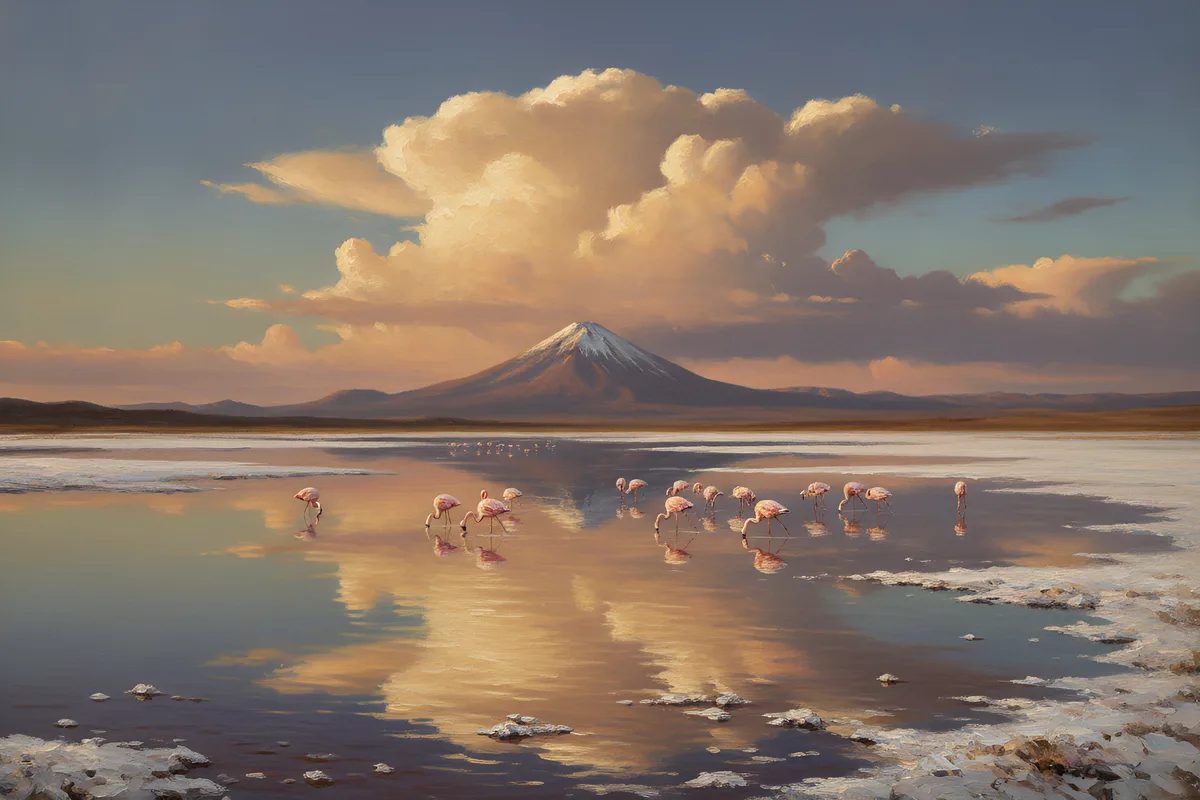
At the centre of the picture a snow-dusted volcano rests on the horizon, its slopes the colour of dried roses and plum. Above it a vast cloud climbs into the blue, its crown still bright with sun, its underside shading toward violet. The whole scene is arranged the way a nineteenth-century canvas would arrange it, with a quiet middle distance, a luminous focal point and a foreground that invites the eye to wade in.
And the eye does wade in. Flamingos stand in the shallows, a loose company of pale pink figures, heads bowed to the water, each one doubled by a trembling reflection. They are small against the scale of the sky, which is exactly the point. Their stillness and the slow pace of their steps set the tempo of the picture.
Below them the lagoon becomes a second sky. Gold pours down through the water in long soft columns, mixing with turquoise-grey and a deep, wine-dark violet where the shadows gather. Along the near shore, crusts of white salt break the surface into small bright islands, painted with thick, dry strokes that catch the light like frost.
The mood is one of unhurried grandeur. Nothing moves quickly here, and nothing needs to. The painting asks only that you stand at the edge of the water for a while, let the colour settle, and watch the afternoon turn slowly toward evening.