
Friday, Nov. 6 —
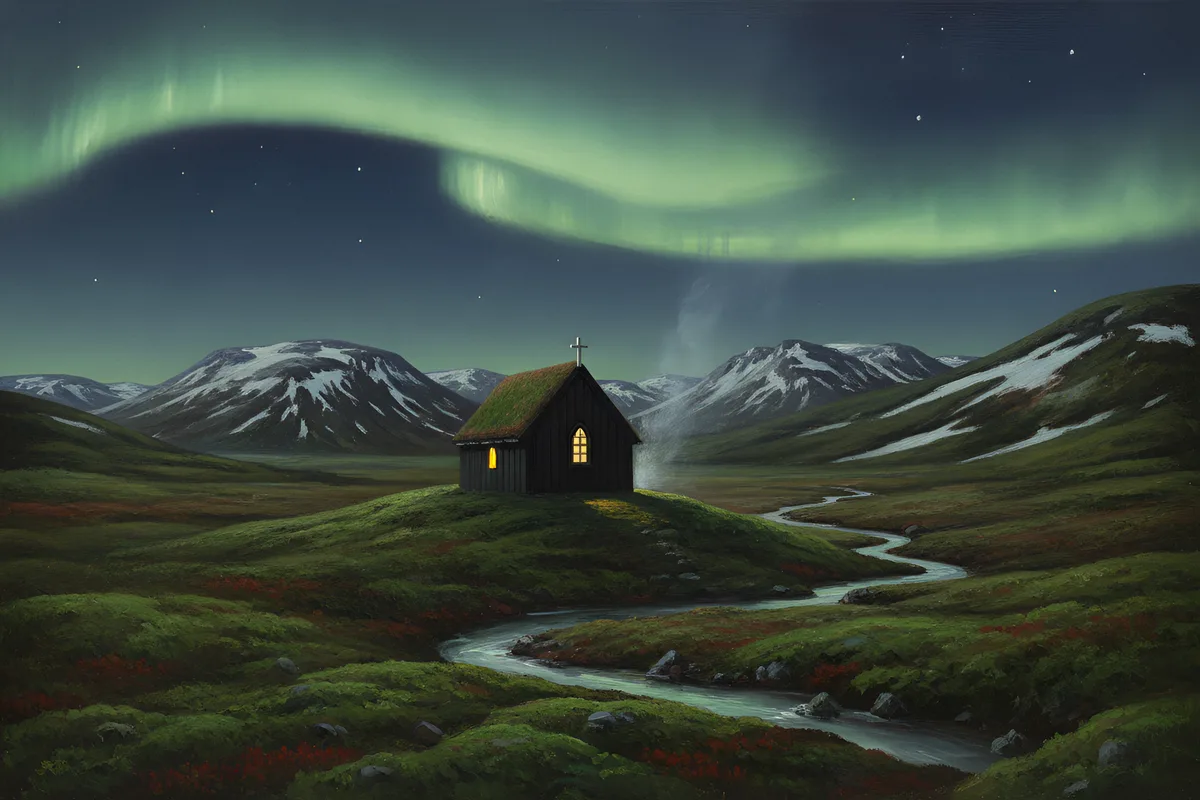
High in an Icelandic valley, far from any road worth the name, a small black chapel sits on a rounded hill of moss. Its roof is a living blanket of turf, green in the day and nearly colourless at night, and a pale cross rises from the ridge like a single stroke of chalk. In the arched window a lamp burns, the only warm colour in the whole scene.
The painting is built around that tiny point of amber. Everything else leans toward cold: the indigo sky, the slate mountains with their streaks of old snow, the pale stream threading through the hollow. The aurora makes a great slow curve across the heavens, soft-edged and luminous, and its green is echoed in the grass and in the faint haze along the horizon, so that land and sky seem to breathe the same colour.
In the spirit of the Nordic National Romantic painters, the forms are simplified and carefully drawn, each hillock and boulder given the polished clarity of a jewel. Patches of red tundra scrub glow low in the foreground like embers, a quiet reminder of autumn lingering at the edge of winter. A thread of steam drifts up from the valley beyond the chapel, hinting at warm ground beneath the cold.
There is no figure in the picture, yet it feels attended. The chapel seems to wait for travellers who may or may not come, its light a small act of hospitality offered to the dark. The mood is stillness rather than loneliness: the hush of a night in which nothing needs to happen, and the sky does all the moving.
Standing before it, one can imagine the silence, broken only by the murmur of water over stones. The stars are sharp, the air is thin, and the aurora slides on, indifferent and generous. It is a painting about shelter, about a lit window, and about how small a human mark can be and still feel like enough.